$15.99Lowest total price
~2-5 business days

Prices last updated Mon, Jun 15
Prices and availability are provided by the retailers and may change. We do our best to keep them current, but always confirm the final price at the store before purchasing.







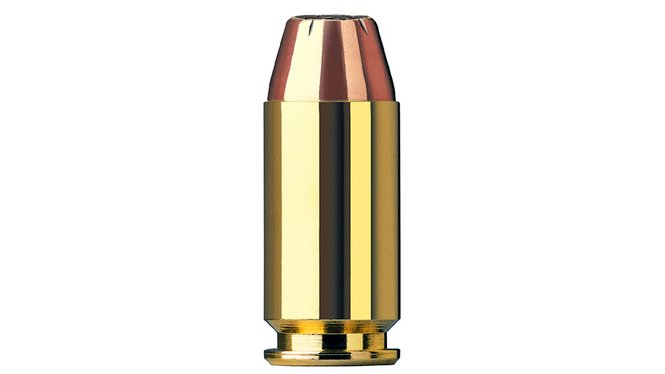
The .40 Smith & Wesson is a powerful handgun cartridge (10.2×22mm) used primarily in law enforcement, action/practical (IPSC) sport shooting, and personal defense, with typical muzzle energies of 525 to 670 Joules (387–494 ft-lbs)—well above 9×19mm. It is characterized by bullet weights between 135 and 180 grains, muzzle velocities of 300 to 365 m/s (985–1,200 ft/s) from 4- to 5-inch barrels, and effective ranges of roughly 15 to 50 meters. It enjoys broad availability of FMJ training ammunition, premium JHP loadings such as Federal HST or Speer Gold Dot, and lead-free copper options such as the Barnes TAC-XP 140 grain.
The .40 S&W has a clear profile: more energy than the 9mm Parabellum, while noticeably more controllable than the 10mm Auto. Anyone looking for a powerful pistol cartridge for sport, duty, or defense use sooner or later encounters this caliber.
The .40 S&W was developed in 1990 jointly by Smith & Wesson and Winchester—as a shortened version of the 10mm Auto, specifically for the requirements of the FBI. The idea was simple: pack the performance of the 10mm Auto into a format that fits more compact frames. The 21.59 mm case length makes exactly that possible.
Metrically, the designation is 10×22mm. Synonyms such as "10mm Smith & Wesson Short" or simply "40 S&W" appear regularly in the trade—they all mean the same caliber. There is no NATO designation.
| Specification | Value |
|---|---|
| Metric designation | 10×22mm |
| Ignition type | Centerfire |
| Bullet diameter | 10.17 mm (0.400 in) |
| Case length | 21.59 mm |
| Overall length (C.I.P. L3 max.) | 28.96 mm |
| C.I.P. p-max | 225 MPa (32,600 psi) |
| SAAMI MAP | 241.32 MPa (35,000 psi) |
| Twist rate | 1:406 mm (1:16 in), 6 grooves |
| Land diameter | 9.91 mm |
| Groove diameter | 10.17 mm |
| Bullet weights | 105–200 grains (6.8–13.0 g), most common 135–180 grains |
| Muzzle velocity (V0) | 360–433 m/s (1,180–1,420 ft/s, depending on load) |
| Muzzle energy (E0) | at least 575 J (424 ft-lbs) (135 gr JHP load) |
A brief note on the pressure figures: C.I.P. and SAAMI measure by different methods and set different limits—225 MPa versus 241.32 MPa. This is not a contradiction but a consequence of two different standardization systems. When reloading and when selecting commercial loadings, you should know which standard applies to your ammunition.
The .40 S&W fires 10mm bullets between 105 and 200 grains (6.8–13.0 g) with documented muzzle velocities of 360 to 433 m/s (1,180–1,420 ft/s) and an E0 of at least 575 J (424 ft-lbs) for the 135 grain JHP load. Energetically, it sits between the 9mm Parabellum and the 10mm Auto.
The .40 S&W is a handgun cartridge with a practical engagement distance of 25 to 50 meters. For greater distances—around 100 m and beyond—it is not designed and not sensibly used.
Muzzle figures are available for two documented loadings. The Federal Premium JHP Reduced Recoil with 135 grains reaches a V0 of 360 m/s (1,190 fps) and an E0 of 575 J (424 ft-lbs). The lighter National Police Ammo SDR loading with 105 grains reaches 433 m/s (1,420 fps)—so the lighter bullet starts faster out of the barrel. As a rule, lighter bullets shed energy faster; without a ballistic coefficient (BC) available, that cannot be quantified exactly here.
Ballistic tables over distance—velocity, energy, and bullet drop at 50, 100, or 200 m—are not available for the .40 S&W in the sources reviewed. A reliable table cannot be built from the available data. In addition, the reference barrel length for the stated V0 figures is not documented, which limits the comparability of the muzzle figures, since V0 depends heavily on barrel length.
The .40 S&W is not a long-range cartridge—and that was never its purpose. For distances beyond 50 m, shooters reach for rifle cartridges. In the close range up to 50 m, the .40 S&W reliably does its job, whether on the range, on duty, or for defense.
Bullet weight and bullet type largely determine how .40 S&W ammunition behaves in use. The spectrum ranges from 105 to 200 grains—the practical center of gravity lies between 135 and 180 grains.
| Bullet type | Typical weight | Use |
|---|---|---|
| FMJ / FMC (full metal jacket) | 180 grains (11.7 g) | Training, sport shooting |
| JHP (jacketed hollow point) | 135 grains (8.7 g) | Expansion, defense, duty |
| SDR (Simulated Duty Round) | 105 grains (6.8 g) | Training (qualification simulation) |
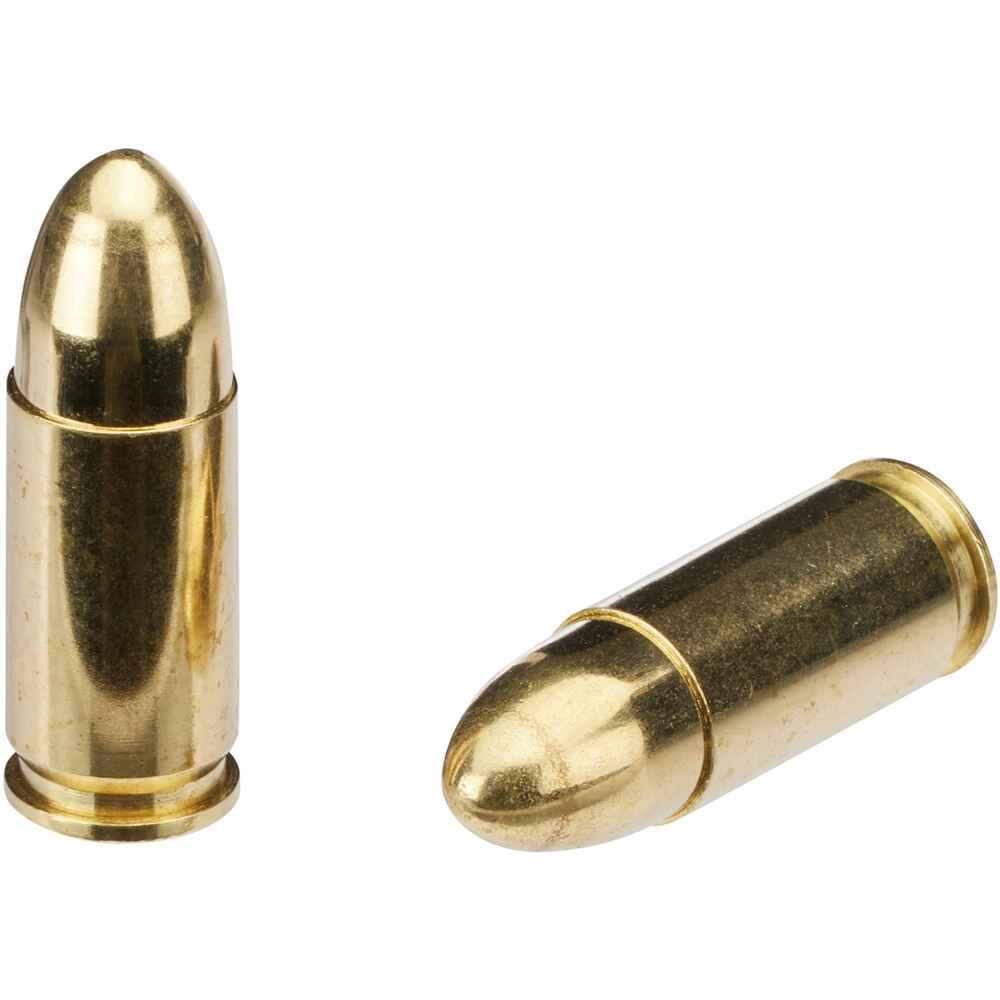
The Magtech .40 S&W FMC with 180 grains is the classic choice for training and the range. Full metal jacket bullets (FMJ/FMC) do not deform and deliver reliable function in nearly all platforms—ideal for high-volume shooting.
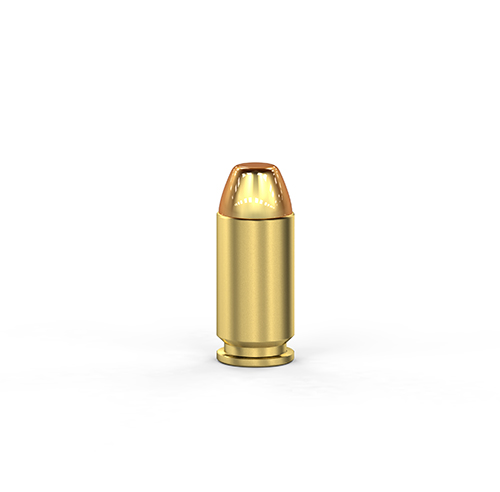
The Federal Premium JHP Reduced Recoil with 135 grains takes a different path. The jacketed hollow point (JHP) deforms on impact and thus transfers more energy to the target. The "Reduced Recoil" design was developed specifically for recoil-sensitive shooters and fast follow-up shots. At 575 J (424 ft-lbs) E0 and 360 m/s (1,190 fps) V0, it offers documented performance data.
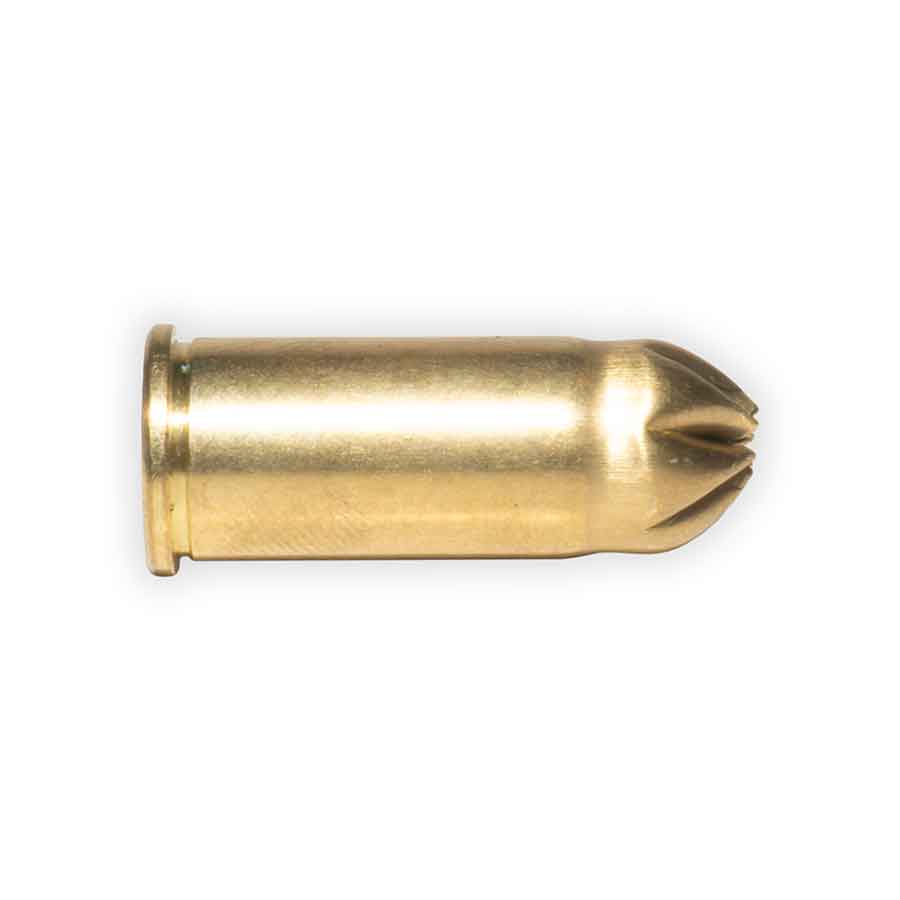
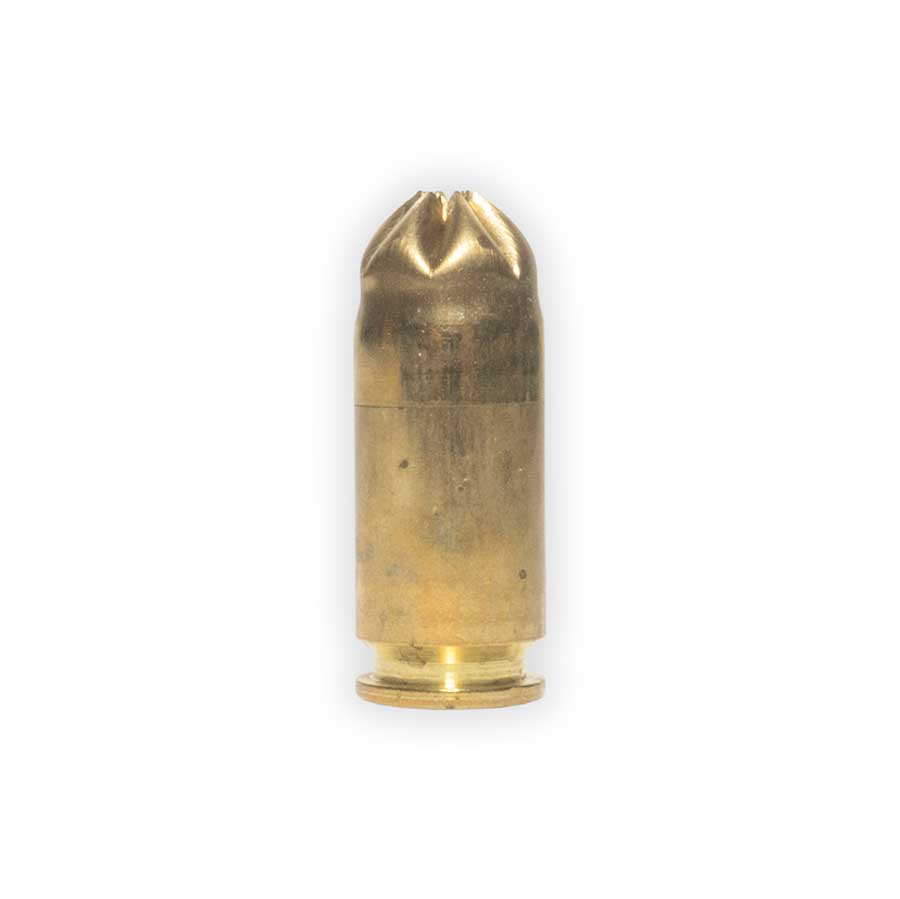
The National Police Ammo SDR with 105 grains is a specialty: as a Simulated Duty Round it serves qualification-course simulation and, at 433 m/s (1,420 fps), reaches the highest V0 in this comparison.
Match ammunition and subsonic loadings in .40 S&W are not documented in the sources reviewed. Ballistic coefficient (BC) is not available for any single loading; estimated values are deliberately not given here.
The .40 S&W is exclusively a handgun caliber. There are no classic rifles for it; individual pistol-caliber carbines are a niche. The focus is on semi-automatic pistols in the medium-frame format with double-stack magazines.
A key design advantage: the .40 S&W was deliberately dimensioned to fit frames originally designed for 9mm cartridges. The short 21.59 mm case makes this possible. The historical reference model is the Smith & Wesson Model 4006, derived from the 4506 design in 10mm Auto.
Typical barrel lengths on compact and full-size pistols range from 90 to 115 mm (3.5 to 4.5 inches). The twist rate is 1:406 mm (1:16 in) with 6 grooves.
Magazines hold up to 18 rounds depending on the model. These pistols are popular for sport shooting (practical/action shooting, Standard/Production) and personal defense.
What can be described from practical experience is well documented: the recoil of the .40 S&W is generally described as noticeably stronger than that of the 9mm Parabellum, but remains more moderate than the 10mm Auto. Anyone switching from 9mm will notice the difference on the first shot.
The 180 grain FMJ loadings are regarded as reliable standard training ammunition that functions without issue in most platforms. It is the workhorse of this caliber family. By contrast, 135 grain JHP reduced-recoil variants—such as the Federal Premium JHP Reduced Recoil—were developed specifically for recoil-sensitive shooters and fast follow-up shots, making them attractive to sport shooters who need to track the sights quickly.
The .40 Smith & Wesson occupies a clear niche: more performance than the 9mm Parabellum, more control than the 10mm Auto.
| Specification | .40 S&W | 9mm Parabellum | 10mm Auto | .45 ACP |
|---|---|---|---|---|
| Bullet diameter | 10.17 mm | 9.01 mm | 10.17 mm | 11.43 mm |
| Case length | 21.59 mm | 19.15 mm | 25.20 mm | 22.81 mm |
| C.I.P. p-max | 225 MPa | 235 MPa | 230 MPa | 131 MPa |
| Typical E0 | ~470–680 J* | ~400–580 J* | ~550–900+ J* | ~350–540 J* |
| Recoil (relative) | medium | low | high | medium-high |
| Magazine capacity (typ.) | 12–16 | 15–19 | 10–15 | 7–13 |
*E0 ranges partly approximate.
The .40 S&W delivers roughly 15 to 25% more muzzle energy than the 9mm Parabellum—at noticeably higher recoil and slightly lower magazine capacity. However, the 9mm Para has caught up considerably in recent years with modern JHP bullets. The FBI switched back from the .40 S&W to the 9mm Parabellum in 2015. For sport shooters, the 9mm Para offers lower cost, less recoil, and higher capacity.
The .40 S&W is the "tamed" version of the 10mm Auto: shorter case, lower pressure, considerably less recoil. Anyone wanting maximum performance from the 10mm platform reaches for the 10mm Auto. Anyone prioritizing controllability while still wanting more than 9mm Para is better served by the .40 S&W.
Against the .45 ACP, the .40 S&W scores with higher muzzle energy in a more compact cartridge format. The .45 ACP relies on a considerably larger bullet cross-section (11.43 mm) at comparatively low working pressure—131 MPa versus 225 MPa for the .40 S&W. The pressure is lower, but the cartridges are larger and magazines correspondingly smaller.
The .40 S&W is a caliber with a clearly defined profile. Its strengths lie in sport shooting, duty use, and personal defense.
Strengths at a glance:
Limits to know: the .40 S&W has steadily lost market share to the 9mm Parabellum in recent years, which may affect availability and pricing over the long term. Lead-free options are not well documented, and reliable ballistic tables over distance are entirely lacking.
For sport shooters in the practical/action disciplines (Standard/Production) who want more performance than the 9mm Parabellum, and for anyone wanting a defensive or duty handgun with ample energy reserve, the .40 S&W offers a proven option. The typical engagement distance is 25 to 50 meters. It is a handgun cartridge only and is not used as a rifle hunting caliber.
We use cookies to keep the site working and to understand how it's used. Learn more in our Cookie Policy.
77 offers