$20.49$0.82 / roundLowest total price
Credova
~4-10 business days

Prices last updated Mon, Jun 15
Prices and availability are provided by the retailers and may change. We do our best to keep them current, but always confirm the final price at the store before purchasing.




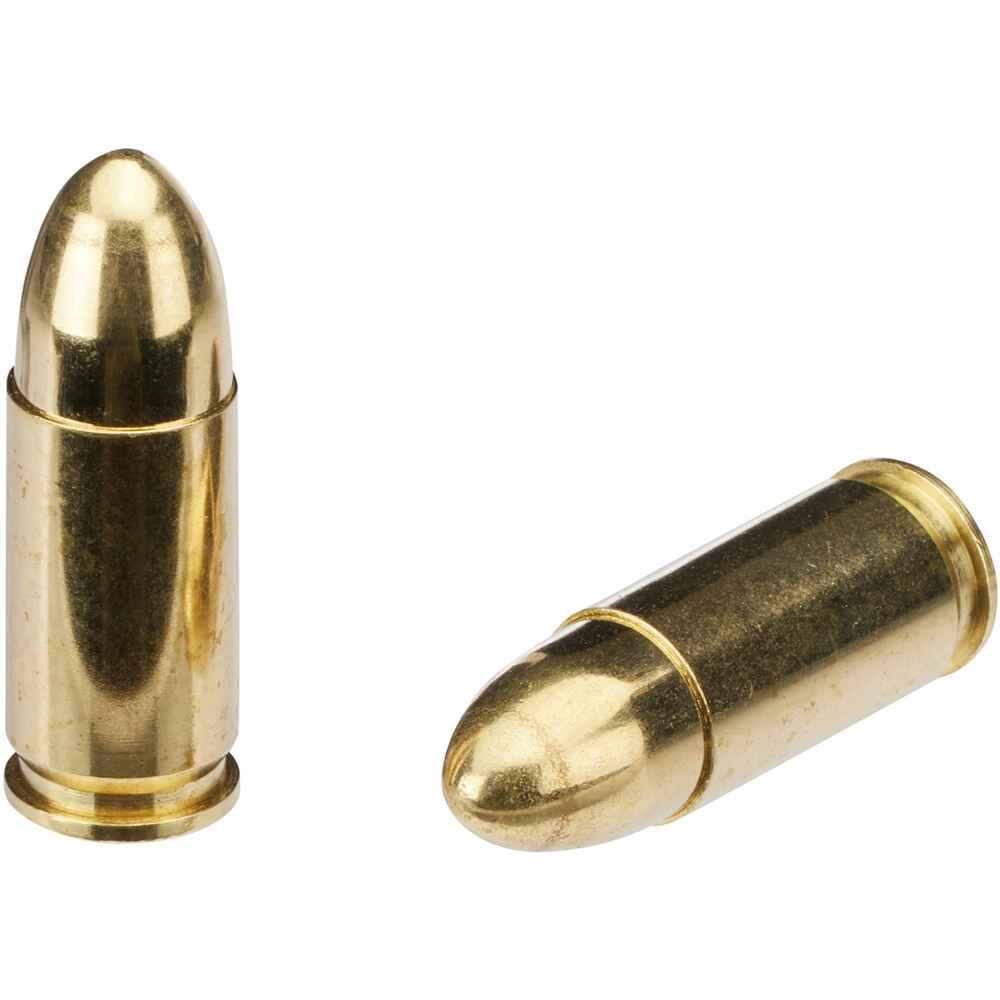
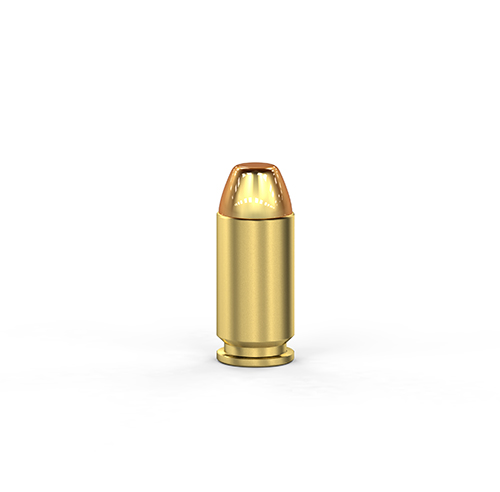
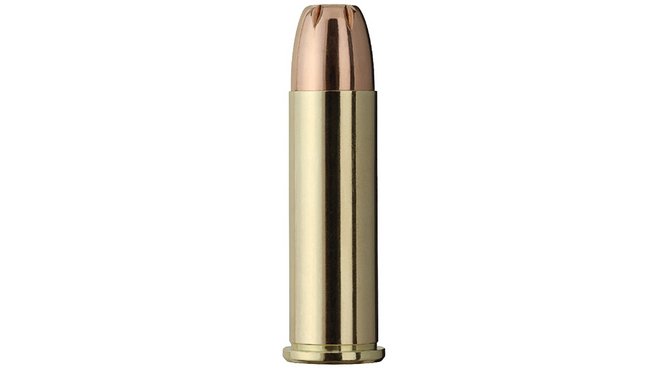
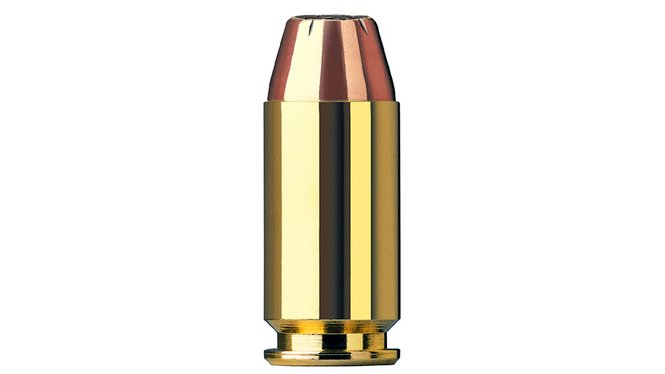
The .45 ACP (Automatic Colt Pistol) is a large-bore handgun cartridge with an 11.43 mm projectile diameter, originally developed in 1905 by John Moses Browning. For more than a century it has been a proven standard cartridge for self-defense, sport shooting, and law-enforcement use. The cartridge is characterized by low muzzle velocities paired with high impact energy, bullet weights of 185 to 230 grains, pronounced terminal effect, and moderate recoil. It is available in full metal jacket, hollow point, and modern expanding (controlled-expansion) bullet designs; its subsonic velocity makes it well suited to suppressor use.
The editorial section of the source page focuses specifically on the high-pressure .45 Auto +P variant, which is detailed below.
The .45 Auto +P is a high-pressure variant of the classic .45 ACP, developed specifically for modern semi-automatic pistols. The "+P" designation signals an increased operating pressure of 158.58 MPa (23,000 psi), roughly 9 percent above the standard .45 ACP at 144.79 MPa (21,000 psi). Sport shooters and professionals value the higher muzzle energy, which can reach up to 835 Joules (about 616 ft-lbs).
The .45 Auto +P is also known as 11.43 mm, .45 ACP +P, or .45 Automatic Colt Pistol (+P). It is a centerfire pistol cartridge with a bullet diameter of exactly 11.43 mm (.451 in). Case length is 22.81 mm (0.898 in) and overall cartridge length is 32.39 mm (1.275 in).
| Specification | Value |
|---|---|
| Metric designation | 11.43 mm |
| Imperial designation | .45 Auto +P / .45 ACP +P |
| Bullet diameter | 11.43 mm (.451 in) |
| Case length | 22.81 mm (0.898 in) |
| Overall cartridge length | 32.39 mm (1.275 in) |
| Max. chamber pressure (SAAMI +P) | 158.58 MPa (23,000 psi) |
| Twist rate (typical) | 1:16 in (406 mm) |
| Bullet weights | 185 gr (12 g), 200 gr (13 g) |
| Muzzle velocity | 320–373 m/s (1,050–1,224 fps) |
| Muzzle energy | 614–835 J (about 453–616 ft-lbs) |
The "+P" marking is a SAAMI (Sporting Arms and Ammunition Manufacturers' Institute) standard defining the elevated maximum pressure. The European C.I.P. (Commission Internationale Permanente) does not list a separate specification for .45 Auto +P. This is an important point: +P ammunition may only be fired in firearms that the manufacturer has explicitly rated for it. Excessive stress can cause increased wear or, in extreme cases, damage.
The .45 Auto +P is effective out to roughly 50 meters (about 55 yards). Beyond that, bullet drop and energy loss become too great for precise hits. As a pistol cartridge it is designed primarily for close range, which is its strength rather than a weakness.
Documented loadings and their muzzle figures:
| Manufacturer | Product | Weight | Bullet Type | Muzzle Velocity | Muzzle Energy | Use |
|---|---|---|---|---|---|---|
| Speer | Gold Dot +P | 200 gr (13 g) | Segmented JHP | 330 m/s (1,083 fps) | 702 J (518 ft-lbs) | Self-defense |
| Speer | Gold Dot | 185 gr (12 g) | Segmented JHP | 320 m/s (1,050 fps) | 614 J (453 ft-lbs) | Self-defense |
| Various | Bonded Defense | 185 gr (12 g) | Bonded | 373 m/s (1,224 fps) | 835 J (616 ft-lbs) | Deep penetration |
With 185-grain bullets the .45 Auto +P reaches muzzle velocities between 320 and 373 m/s and muzzle energies of 614 to 835 Joules, depending on the specific load. The Bonded Defense loading (185 gr) offers the highest figures of the three documented variants at 373 m/s and 835 Joules. The 53 m/s spread between the slowest and fastest bullet points to meaningfully different powder charges.
A notable data gap exists beyond the muzzle: for none of these three loadings are reliable ballistic tables (velocity and energy at 50, 100, 200, or 300 meters) published, and manufacturers do not list a ballistic coefficient (BC). A well-founded statement about energy retention at longer distances is therefore not possible. The .45 Auto +P is not suited to long range; with its large bullet diameter (11.43 mm), relatively low velocity (320–373 m/s), and high drag, it drops off noticeably by 50 meters. Effective use is in the 25-to-50-meter range, and for precision shooting, distances of about 7 to 25 meters are typical. Shooters interested in longer distances should choose a rifle cartridge.
The common bullet weights for .45 Auto +P are 185 grains (12 g) and 200 grains (13 g). The lighter 185-grain bullet reaches higher velocity (up to 373 m/s), while the heavier 200-grain bullet combines somewhat lower velocity (330 m/s) with greater momentum. In practical terms: 185 grains for broader effect, 200 grains for deeper penetration.
The available bullet types differ markedly in construction:
Speer is the best-documented manufacturer, with specifically named products such as Gold Dot and Gold Dot +P. Other common makers of .45 ACP +P, such as Federal, Hornady, and Winchester, are widely available on the US market. Lead-free .45 Auto +P loadings were not documented in the source material; the selection of +P loadings is generally smaller than for standard .45 ACP.
The .45 Auto +P is fired exclusively in semi-automatic pistols. The +P rating requires a firearm explicitly designed for the elevated chamber pressure (158.58 MPa / 23,000 psi). Not every pistol rated for standard .45 ACP is automatically +P-capable; manufacturers state +P approval explicitly in the owner's manual.
The M1911A1 is the best-known platform for the .45 Auto and serves as the basis for many manufacturers' designs. Modern M1911 variants from Colt, Springfield Armory, Kimber, or SIG Sauer are frequently rated for +P when built to current manufacturing standards. Older M1911 models from military surplus should never be fired with +P ammunition; the risk is too high.
Additional platforms are available on the market, including:
Typical barrel lengths for .45 Auto pistols range from 4 inches (about 10 cm) on compact models to 5 inches (about 12.7 cm) on full-size pistols such as the M1911 Government model. The usual twist rate is 1:16 in (406 mm), which provides adequate stabilization for the subsonic velocity and heavy bullets. Before using +P ammunition, the firearm must be explicitly rated for it; the elevated chamber pressure can cause increased wear, malfunctions, or in extreme cases damage in firearms not designed for it.
+P ammunition produces noticeably more recoil than standard .45 ACP. With chamber pressure raised by about 9 percent and energy by up to 36 percent (Bonded Defense versus a typical standard load of roughly 600 J), the shooter feels the difference clearly. For sport shooters this can mean a longer familiarization period; for single-shot applications the recoil difference is less critical.
Independent field-test data (group sizes, expansion, penetration depth) from firearms media was not available in the source material for these specific loadings. As a practical approach, buyers should test any new loading in their own firearm (at least 50 rounds) to verify reliability and function, and for sport use compare precision between bullet weights (185 gr vs. 200 gr) at 25 meters. Manufacturers often publish expansion and penetration data on their websites, frequently based on the FBI protocol in ballistic gelatin; these figures offer a reference point but do not replace testing in one's own firearm.
Anyone considering .45 Auto +P should also weigh related calibers, depending on priorities for pressure, energy, availability, and recoil.
| Caliber | Max. Pressure | Typical Muzzle Energy | Use |
|---|---|---|---|
| .45 Auto +P | 158.58 MPa (23,000 psi) | 614–835 J | Self-defense |
| .45 Auto | 144.79 MPa (21,000 psi) | ~550–650 J | Sport, historic |
| 10 mm Auto | 259 MPa (37,500 psi) | ~700–850 J | Hunting (partly), self-defense |
| .40 Smith & Wesson | 241 MPa (35,000 psi) | ~600–750 J | Duty, sport |
The practical recommendation depends on priorities: those who need the widest availability and broadest ammunition selection are better served by standard .45 ACP; 10 mm Auto offers maximum energy where firearm and ammunition are available; .40 S&W is a compromise between performance and availability; and .45 Auto +P combines tradition with moderate +P performance where available.
The .45 Auto +P offers muzzle energies of 614 to 835 Joules, with JHP and bonded bullets delivering reliable effect at close range. The M1911 and modern semi-autos such as the Glock 21 or SIG P220 are established platforms on which +P ammunition runs safely. The +P variant reaches about 9 percent more pressure and up to 36 percent more energy than standard .45 ACP. Its limits: it is not a long-range cartridge (effective range under 50 meters), independent test data and BC values are not published, and only +P-rated firearms may fire it. Ideal applications are self-defense and duty use, and sport shooting at short distances (7 to 25 meters), provided the firearm is rated for +P. Shooters who need broad ammunition selection, lead-free options, or lower recoil should prefer standard .45 ACP.
We use cookies to keep the site working and to understand how it's used. Learn more in our Cookie Policy.
78 offers