$18.49$0.92 / roundLowest total price
Credova
~4-10 business days

Prices last updated Mon, Jun 15
Prices and availability are provided by the retailers and may change. We do our best to keep them current, but always confirm the final price at the store before purchasing.







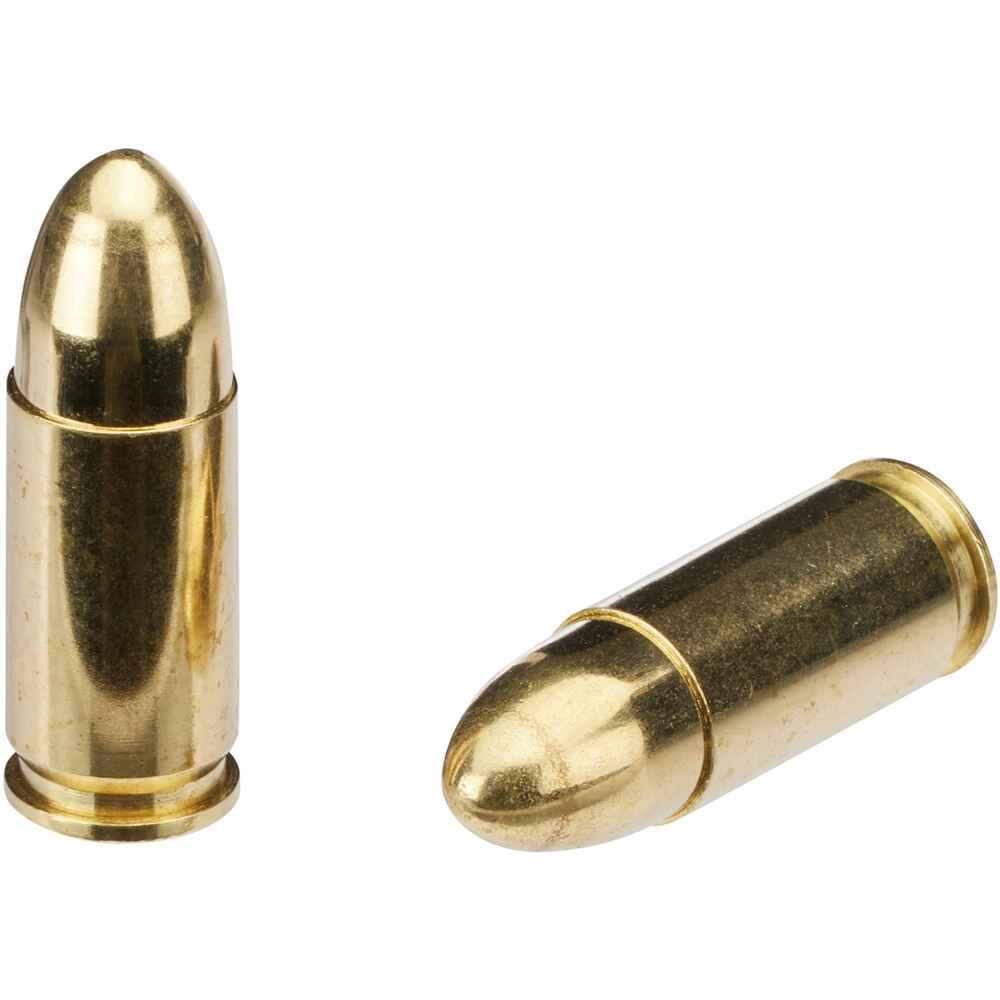
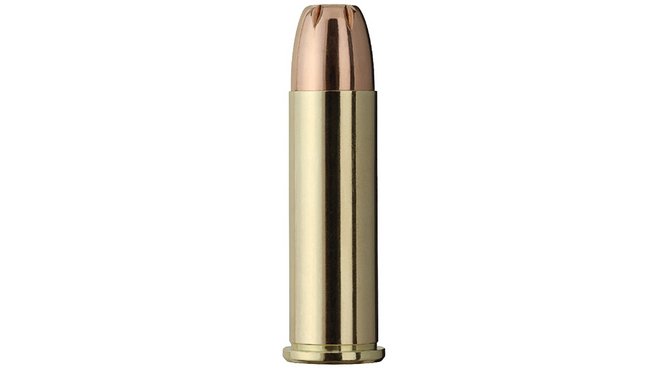
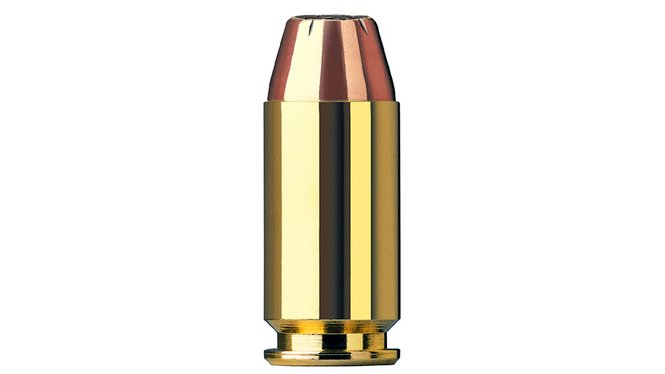
The 10mm Auto is a powerful pistol cartridge for semi-automatic handguns, developed in 1983 by Jeff Cooper and Norma. It delivers muzzle energies around 737 Joules (180-grain FMJ, about 543 ft-lbs) and velocities up to 471 m/s (1,545 fps). It is one of the most energetic pistol cartridges available, with distinctly higher energy than the .40 S&W or .45 ACP, a flatter trajectory than classic pistol calibers, and high magazine capacities (15+1 rounds in the Glock 20). Available bullet weights run from 100 to 220 grains (180 grains is the standard), with typical C.I.P. pressures of 230 MPa. Effective range is roughly 25 to 50 meters.
The 10mm Auto is a high-performance centerfire handgun cartridge fired in semi-automatic pistols. Norma originally developed it for the FBI, and it remains one of the most energetic pistol cartridges ever produced. In performance it sits between the .45 ACP and the .357 Magnum. Its main roles today are sport/competition shooting, self-defense (especially in the US market), and hunting applications such as finishing shots and short-range field use.
The designations 10mm Auto (C.I.P.), 10mm Automatic (SAAMI), and 10x25mm all describe the same cartridge. No NATO designation exists. When searching spec sheets or online shops, you may encounter all three names depending on the source and country of origin.
| Specification | Value |
|---|---|
| Bullet diameter | 10.74 mm (C.I.P.) / 10.7 mm (SAAMI) (.400 in) |
| Case length | 25.20 mm (0.992 in) |
| Overall cartridge length | 32.00 mm (1.260 in) |
| Max. pressure (C.I.P.) | 230 MPa |
| Max. pressure (SAAMI) | 37,500 psi (≈ 259 MPa) |
| Twist rate (typical) | 406.4 mm (1:16 in), 6 grooves |
| Type | Centerfire, handgun |
Note: C.I.P. and SAAMI pressure values are not directly comparable because they are based on different measurement methods; SAAMI loadings can be specified higher.
The 10mm Auto covers a bullet-weight spectrum from 100 gr (6.5 g) to 215 gr (14 g), with the most common loadings at 170 to 180 gr. Depending on bullet weight and load, muzzle velocities range from about 366 m/s (1,200 fps) for 180-grain loads up to 471 m/s (1,545 fps) for Lehigh Defense's light 100-grain loading. Muzzle energies run from around 776 J (documented for the Speer TMJ 155-grain load) up to an estimated just under 800 J for standard 180-grain loads.
For handloaders, two differences matter: C.I.P. and SAAMI differ in bullet diameter (10.74 mm vs. 10.7 mm) and maximum pressure (230 MPa vs. ≈ 259 MPa). This is relevant because American load data is based on SAAMI pressure limits and should not be transferred directly to European C.I.P.-spec firearms.
The 10mm Auto is a handgun cartridge, so its effective range is well below that of rifle cartridges. The figures below are limited to documented muzzle values and general assessments.
| Loading | Bullet | Weight | Muzzle Velocity | Muzzle Energy | BC |
|---|---|---|---|---|---|
| Lehigh Defense Xtreme Defense | Xtreme Defense | 100 gr (6.5 g) | 471 m/s (1,545 fps) | — | — |
| Speer TMJ | TMJ | 155 gr (10 g) | — | 776 J (572 ft-lbs) | — |
| Lehigh Defense Controlled Fracturing | Controlled Fracturing | 215 gr (14 g) | — | — | G1 0.33 |
| Typical 180-gr load (reference) | various | 180 gr (11.7 g) | ~366 m/s (1,200 fps) | ~785 J (579 ft-lbs, calculated) | — |
Note: muzzle velocities are only loosely comparable without a stated reference barrel length. The ~785 J figure for 180 gr is calculated from velocity and mass, not a verified manufacturer value.
Documented distance ballistics (energy at 50, 100, or 200 m) and bullet-drop curves were not available in the source material. As a handgun cartridge, the 10mm Auto sheds energy much faster than rifle calibers; with a muzzle energy around 780 J and typical handgun barrel lengths of about 100 to 150 mm, retained energy at 100 m is expected to fall well below 500 J. It is not a long-range cartridge; it is designed for handgun distances, typically out to about 50 m.
The velocity spread (from ~366 m/s with the 180-grain standard load to 471 m/s with the 100-grain Lehigh Defense load) looks unusually large at first glance. It is explained by the broad bullet-weight range: lighter bullets leave the barrel faster but also shed energy more quickly. The 100-grain Lehigh Defense loading is therefore not representative of standard loads and should not be used as a baseline for typical 10mm Auto performance.
The bullet offering for the 10mm Auto runs from 100 gr to 215 gr and includes classic full metal jacket and hollow-point bullets as well as specialized CNC-machined designs. The right bullet type depends directly on the intended use, whether sport, defense, or hunting.
| Bullet Type | Example Product | Weight | BC | Use | Lead-Free |
|---|---|---|---|---|---|
| FPJ (Flat Point Jacket) | Yugoimport A-361 | 170 gr (11 g) | — | Sport, general | No (lead/antimony) |
| JHP (Jacketed Hollow Point) | (no specific product cited) | 180 gr (11.7 g) typical | — | Hunting, defense | — |
| TMJ (Total Metal Jacket) | Speer TMJ | 155 gr (10 g) | — | Sport / training | — |
| Xtreme Defense | Lehigh Defense Xtreme Defense | 100 gr (6.5 g) | — | Defense, sport | — |
| Controlled Fracturing | Lehigh Defense Controlled Fracturing | 215 gr (14 g) | G1 0.33 | Hunting (fragmenting effect) | — |
| FMJ (Full Metal Jacket) | (no specific product cited) | various | — | Sport / training | No (standard) |
Note: a BC value is only available for the Lehigh Defense Controlled Fracturing (G1 0.33); BC figures are missing for all other loadings in the available sources.
Yugoimport offers the A-361, an FPJ cartridge with a lead core, positioned more in the budget segment with a military/agency background. Speer's TMJ line is established for training ammunition; the full encapsulation reduces lead exposure on indoor ranges. Lehigh Defense represents the premium segment with CNC-machined specialty bullets such as the Xtreme Defense and the Controlled Fracturing, with specific terminal mechanisms that go beyond classic constructions. Federal historically developed the so-called "FBI Lite" loading, a reduced load for lower recoil. Norma, the cartridge's originator, is also active in the market.
No explicitly lead-free 10mm Auto loading could be identified in the source material; the Lehigh Defense bullets are made of copper or a copper alloy depending on the version. The Yugoimport A-361 FPJ uses a lead-antimony core. Shooters who require lead-free ammunition should verify manufacturer specifications in advance. No explicit subsonic or match loadings for the 10mm Auto were found in the source material.
The 10mm Auto is fired exclusively in semi-automatic pistols. Internationally there are a number of established platforms to choose from. Specific model names were not detailed in the source, but well-known platforms for the 10mm Auto include models from Glock (G20, G29, G40 MOS), Colt (Delta Elite), Dan Wesson, SIG Sauer, and EAA Witness.
Typical barrel lengths for 10mm Auto pistols range from about 100 mm on compact models to over 150 mm on long-slide variants. As a rule of thumb, shorter barrels reduce muzzle velocity and therefore muzzle energy, a relevant factor in any cartridge with finite energy reserves.
Independent test data (accuracy, group sizes, recoil, terminal performance) from firearms media was not available in the source material. By design, the cartridge has noticeable recoil, higher than the .40 Smith & Wesson and the .45 ACP. This was historically one of the main reasons for the development of the .40 S&W as a softer-shooting alternative, prompted by the FBI, which originally adopted the 10mm Auto. The caliber is regarded as accurate but demanding to handle: shooters who do not actively control recoil give up follow-up-shot speed.
The 10mm Auto is a specialist caliber with clear strengths and clear limits. Its strengths: a powerful handgun cartridge with muzzle energies around 776 to 785 Joules, a broad bullet-weight spectrum (100 gr to 215 gr) for varied uses, and a bullet diameter over 10 mm that offers good wound ballistics for a handgun cartridge. Its limits: noticeable recoil that challenges inexperienced shooters, and a thin data picture (no reliable distance ballistic tables, no independent field tests in the source material). It suits shooters who want a powerful cartridge for hunting and defense while also using a handgun for sport and training. For sport shooters it is an interesting alternative to the .45 ACP and .40 S&W, with higher velocity and a flatter trajectory. Those seeking a broader-purpose hunting handgun cartridge may also consider the .357 Magnum and .44 Remington Magnum, both of which offer higher energy and a wider ammunition selection.
We use cookies to keep the site working and to understand how it's used. Learn more in our Cookie Policy.
78 offers