
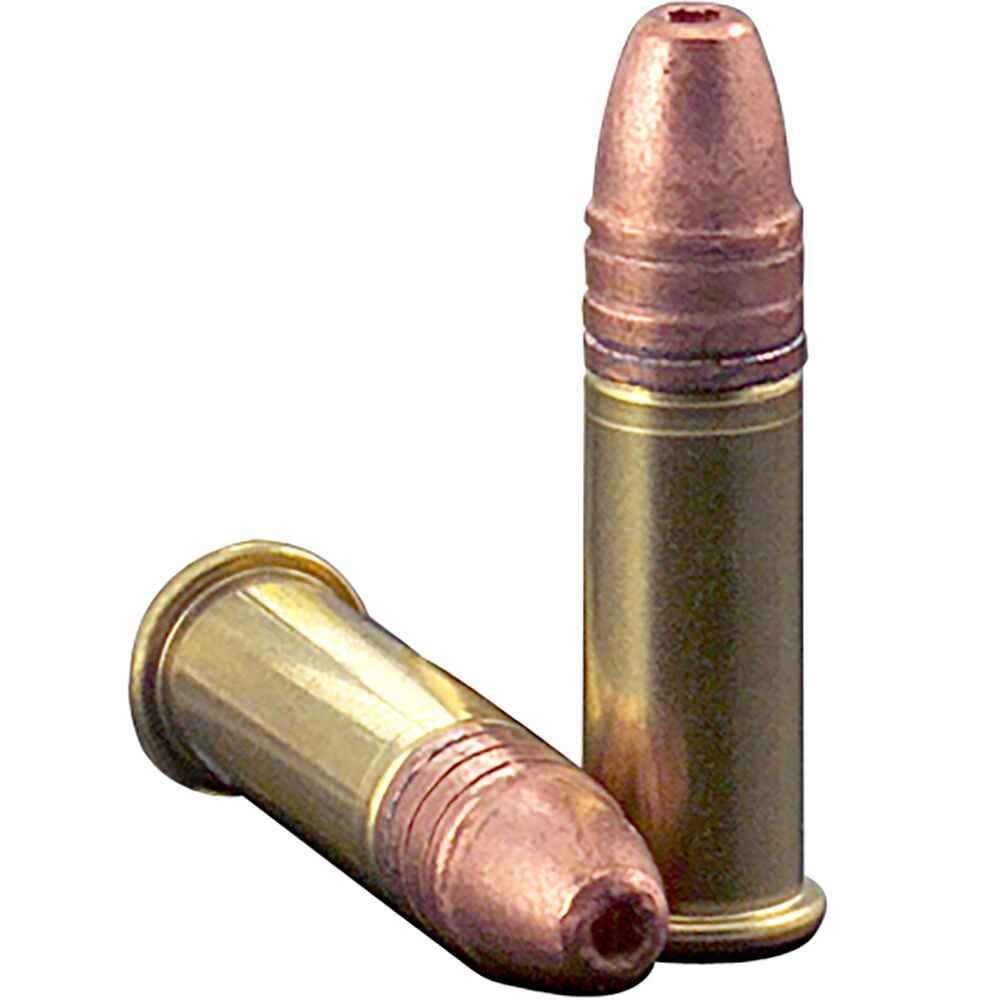
Best price.22 LR Blazer · 40gr · Other · Brass
$4.99Lowest total price
~3-6 business days

Prices last updated Mon, Jun 15
Prices and availability are provided by the retailers and may change. We do our best to keep them current, but always confirm the final price at the store before purchasing.






The .22 Long Rifle (.22 LR, metric 5.6 × 15 mm R) is a globally widespread rimfire cartridge for small-bore rifles and pistols. It is used in sport shooting, training, small-game hunting, and for finishing shots and trapping. Its hallmarks are bullet weights of 36–40 grains, muzzle velocities of 310–405 m/s depending on the load (Standard Velocity about 329 m/s / 140 J, High Velocity about 405 m/s / 213 J, Subsonic about 310 m/s / 125 J), a standard twist rate of 1:16 in, and a maximum C.I.P. pressure of 170 MPa. Ballistic behavior and practical range depend heavily on the chosen load, the bullet type (FMJ, hollow point, match), and the barrel length.
The .22 LR is the best-selling rifle cartridge in the world and has been the backbone of small-bore shooting for decades. Whether in training, in the field on small predators, or in competition on the small-bore range, it is found in nearly every shooter's hands.
The .22 LR is a rimfire cartridge, meaning the priming compound sits in the folded rim of the case rather than in a central primer. This makes the cartridge simple to manufacture and inexpensive, but it cannot be reloaded, since a fired case cannot be re-primed. It is made internationally to SAAMI and CIP standards, ensuring high compatibility worldwide. The G1 ballistic coefficient is 0.172, typical for a small-bore cartridge — a value describing how well the bullet retains its momentum through the air.
| Specification | Value |
|---|---|
| Ignition system | Rimfire |
| Designation | .22 Long Rifle |
| BC (G1) | 0.172 |
| Standards | CIP / SAAMI |
| Bullet diameter | 5.7 mm / .224 in (nominal) |
| Typical bullet weight | about 40 gr / 2.6 g (standard load) |
| Standard twist rate | 1:16 in (406 mm) |
| Max C.I.P. pressure | 170 MPa |
For practical hunting use, the .22 LR is reliably accurate out to about 50 meters. In sport shooting, distances of 100 to 150 meters are regularly engaged at good ranges. In specialized competition formats such as NRL22 — a long-range rimfire format originating in the United States — targets beyond 300 yards (about 274 m) are even addressed.
It is important to understand that the .22 LR is not a long-range cartridge in the classic sense. Its bullet loses energy and velocity relatively quickly, is sensitive to crosswind, and shows significant drop at longer distances. With a G1 BC of 0.172, its aerodynamic efficiency is much lower than that of typical centerfire cartridges.
Note on a ballistic table: a reliable table of velocity, energy, and drop at 50, 100, and 150 meters can only be built from verified muzzle velocities (V0) from manufacturer data sheets or technical-media tests. While approximate values can be calculated from the 0.172 (G1) BC using ballistic calculators such as JBM Ballistics or Strelok, they remain speculative without a valid V0 starting value and are therefore not published here as facts.
The selection of .22 LR ammunition is remarkably broad, from inexpensive training rounds to high-precision match cartridges for Olympic disciplines. The choice of load significantly affects precision, energy, and reliability.
Standard Velocity — subsonic (about 330 m/s), typically a 40 gr / 2.6 g lead round-nose (LRN) bullet. The classic choice for training and beginners: reliable and inexpensive.
High Velocity (HV) — supersonic at about 370–400 m/s, flying faster and flatter. Typical weights are 36 to 40 gr, often copper-plated. Widely used for hunting and general shooting.
Subsonic — optimized for use with sound suppressors. Velocity stays below the sound barrier (about 300–315 m/s), avoiding the ballistic crack. Typical weights: 40–42 gr.
Match / Target — tightest manufacturing tolerances, most uniform powder charges, carefully selected bullets. Round-nose (LRN), about 40 gr, about 320–330 m/s. The choice for small-bore competition and precision-oriented shooters.
Hollow Point — the bullet nose is hollow, producing controlled expansion on impact. Suitable for hunting use (small predators, rabbits). Available in HV and standard variants.
Hyper Velocity — the fastest .22 LR loads at about 430+ m/s. Lighter bullets (30–32 gr) allow the highest muzzle velocity, but with less retention downrange.
.22 LR Shot — a niche product with fine shot pellets inside the bullet. Useful only at the very shortest distances, e.g. for snakes or pest control in tight quarters.
| Segment | Example makers and products |
|---|---|
| Budget | Geco, Winchester Wildcat, Federal AutoMatch, Remington Golden Bullet |
| Mid-range | CCI Standard Velocity, CCI Mini-Mag, Norma TAC-22, Federal Champion |
| Premium / Match | Lapua Center-X, Lapua Midas+, RWS R50, SK Rifle Match, Eley Tenex, Eley Match |
Lead-free variants of the .22 LR exist but are notably rarer in the market than for centerfire cartridges. A well-known example is the CCI Copper-22 with a 21-grain copper hollow point. Availability should be checked before purchase, as the assortment changes regularly.
The .22 LR's enormous popularity comes from its versatility. In sport, it dominates small-bore shooting at the national level and in Olympic disciplines. Thanks to minimal recoil and inexpensive ammunition, it is the ideal entry point into rifle shooting for beginners. Hunters use it on small predators and small game. It also suits pest control (nutria, muskrat) and, with suppressor-optimized subsonic loads, especially quiet operation.
The .22 LR is not suitable or appropriate for big game of any kind — not roe deer, wild boar, or red deer. Its energy is far too low for hoofed game. Where permitted, its hunting use is limited to small predators and small game.
Situations where the .22 LR is commonly applied for hunting and pest control:
Hunting regulations governing the .22 LR vary by jurisdiction; always confirm the applicable local law before field use.
Few calibers are available in as many different firearm platforms as the .22 LR, which makes platform selection both complex and interesting. The offering broadly divides into bolt-action rifles, semi-automatics, and match rifles.
Bolt-action rifles are the first choice for precision-oriented shooters and hunters. Proven models include the CZ 457 (modular system, excellent value), the Anschütz 1416 / 1710 (excellent triggers, very popular on small-bore ranges), the Tikka T1x (modern ergonomic design from Sako), the Ruger American Rimfire (affordable entry with good precision), and the Savage Mark II (reliable entry-level bolt-action with AccuTrigger).
Semi-automatics use recoil or gas operation for automatic ejection and reloading. They are the preferred choice for dynamic disciplines and recreational shooting. Examples include the Ruger 10/22 (the de facto standard among .22 LR semi-autos worldwide, with countless accessory and conversion options), the CZ 512, the Browning SA-22 (a classic design proven for decades), and the Smith & Wesson M&P 15-22 (AR-15 styling in rimfire format, popular in sport shooting).
Match rifles for top-level competition include the Anschütz 54 / 1913 (a reference rifle in small-bore competition) and the Walther KK500 (modern match rifle with high adjustability).
The .22 LR reaches its optimal muzzle velocity already with relatively short barrels of about 40–50 cm (16–20 in). Longer barrels over 60 cm bring almost no velocity gain and can even produce slightly lower V0 through friction losses. Match rifles with long barrels benefit mainly from improved handling (balance and a longer sight line), not from higher velocity. The typical twist is 1:16 in (406 mm); some match barrels use 1:15 or 1:14 in.
| Segment | Example models |
|---|---|
| Entry | Savage Mark II, Ruger American Rimfire |
| Mid-range | CZ 457, Tikka T1x, Ruger 10/22 |
| Premium / Match | Anschütz 1710, Anschütz 1913, Walther KK500 |
Precision — what is realistic? The .22 LR is notably ammunition-sensitive: the same rifle can show considerably different group sizes with different loads — differences of a factor of 3 to 5 at 50 meters are not unusual. A systematic ammunition test with one's own rifle is therefore recommended. As a rough guide for group sizes at 50 meters:
The rimfire trait — misfires. A systemic disadvantage of rimfire ammunition is the misfire rate. Rimfire cartridges fail statistically more often than comparable centerfire cartridges, because the priming compound in the case rim cannot be distributed as uniformly as in a central primer. In everyday use the risk is small, but it is higher with cheaper ammunition than with premium loads.
Practical buying rule. Buy smaller quantities of various loads first and test them in your rifle for precision. Only then is it worth buying larger pack sizes (500- or 1,000-round packs), which significantly lower the cost per round.
The .22 LR is the ideal entry-level and training cartridge for hunters and sport shooters. As the world's best-selling rifle cartridge, it offers maximum availability, the broadest selection of firearms and ammunition of any rifle caliber, and the lowest recoil among rifle cartridges. It is also among the least expensive cartridges per round — a benefit that quickly becomes noticeable in intensive training.
Strengths at a glance:
Limits to be clear about: For hunting, it is limited to small predators and small game; big game is excluded. Effective hunting range is about 50 meters. Wind sensitivity at longer distances, system-inherent misfires (the rimfire principle), and the lack of reloadability are further constraints buyers should know.
For training and sport there is hardly a better choice than the .22 LR. For anyone entering shooting, seeking a small-bore rifle for Olympic disciplines, or simply wanting to train cost-effectively, it is an ideal partner. For hunters it is a sensible complement — but not an all-round caliber.
We use cookies to keep the site working and to understand how it's used. Learn more in our Cookie Policy.